Why is habitat restoration necessary?
Habitat restoration is necessary to help nature stay in balance. However, nothing is simple in this balance – the sum of many factors creates conditions that cause the need for active action so that habitats remain diverse and rich. Such factors are, for example:
Our cool climate and cold winters (when the temperature can drop to -20 or -30°C) can cause high mortality in animals that winter on land or in shallow ponds that freeze to the bottom. In turn, due to heat and drought in the summers, shallow ponds tend to dry up completely. As a result, amphibian larvae often die before they have even managed to grow up.
Decades of agricultural expansion, wetland drainage, and the straightening of small rivers into drainage canals have destroyed tens of thousands of small water bodies that served as homes for amphibians. Due to the abandonment of agricultural lands, the remaining ponds and meadows are rapidly overgrown with bushes and reeds, becoming too dark and cold for sun-loving reptiles and amphibians. Beaver dams, which naturally create ideal ponds for amphibians, are also often destroyed by humans.
Amphibians also die en masse on roads during spring and autumn migrations. An additional threat is the burning of spring dry grass, in which animals perish. Abandoned buildings, open wells, and illegal dumps become traps.
These factors combined create an environment in which it is harder for native herpetofauna to survive and develop.
In Latvian nature, invasive species are usually predators; for example, the rotan fish (Perccottus glenii) is spreading rapidly and is able to completely destroy amphibian larvae in small, warm ponds. Other predators, such as raccoon dogs and American mink, which hunt both adult amphibians and eat turtle eggs, also pose a threat.
Due to the actions of irresponsible people, red-eared sliders (Trachemys scripta) end up in the wild and become aggressive competitors to our native pond turtles in the fight for food and basking spots.
Invasive species exist not only in the animal world but also in the plant world. Species such as the Canadian goldenrod and the ash-leaved maple take over habitats, outcompeting native plants and overshadowing pond shores. This deprives reptiles of the necessary solar heat.
As a result of the exotic animal trade, new, dangerous parasites and diseases also end up in the wild, such as the Batrachochytrium dendrobatidis (Bd) infection.
How is habitat restoration carried out?
To balance the situation, nature experts in Latvia implement several degrees of protection – from legislation and the creation of micro-reserves to the physical reconstruction of habitats and species reintroduction (return to the wild). In places where natural processes have stopped (for example, in an urban environment), they must be artificially imitated.
Habitat restoration works in nature often look like interference, but in reality, they mimic essential, but lost, natural processes, for example:
- Imitation of beaver impact – experts cut down bushes and saw out invasive trees along the shores of water bodies. This restores sunlight access to the ponds and allows amphibians and reptiles to warm up.
- Imitation of drought – new, shallow ponds and pools (puddles) are created. Shallow water warms up faster, providing an ideal environment for the breeding process of newts and turtles.
- Imitation of fire – overgrowth and the grass layer are removed in special places, exposing sandy soil. Such sunny and open sand zones are critically important for pond turtles and sand lizards for safe egg-laying.
- Imitation of spring floods – cleaning of water bodies and forest habitats is carried out, removing accumulated mud and waste left by humans.
When the habitat is prepared, it is often necessary to help native species regain the territory. Scientists breed rare amphibians (for example, fire-bellied toads and tree frogs) and then release the young into the restored ponds.
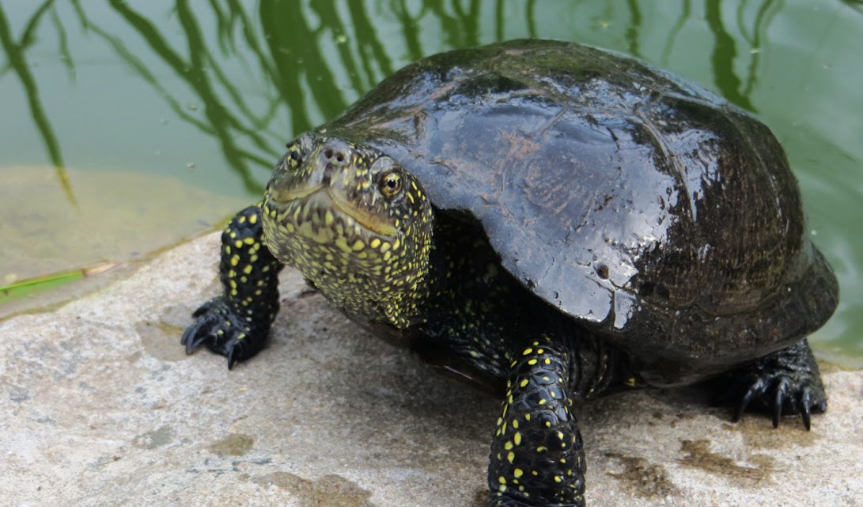
European pond turtles are also specially bred and released into the wild. For example, in the Daugavpils (Ruģeļu) project, it is planned to release 10 turtles, which will not only restore their population but also help fight the invasive rotan fish by eating it.
A large part of the negative impact can be prevented by educating the public, for example:
- Explaining that exotic pets (such as red-eared sliders) must not be released into the wild or invasive fish spread.
- Prohibiting and controlling the use of nets and traps in ponds so that rare pond turtles do not accidentally perish in them.
There is a possibility that climate change will create more favorable conditions for endangered species. If the climate becomes significantly warmer, there is a possibility that the Baltic territory will become an important refuge for the aforementioned species. However, at the same time, the spread of invasive species must also be monitored so that predatory invasive species do not overwhelm the natural inhabitants of the habitat.